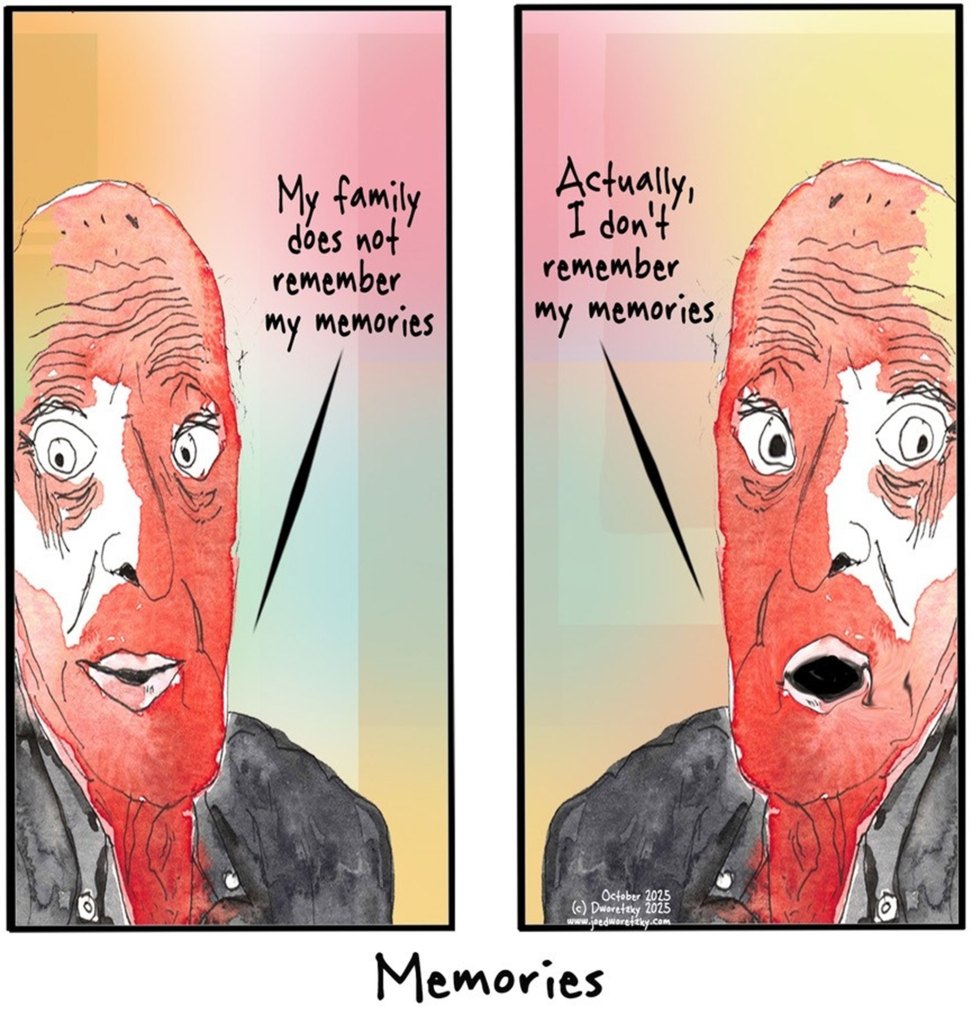
AMONG THE MANY TROPES associated with aging is the idea that as we get older, forgetfulness inevitably arises. You can’t find your keys or your phone. You can’t recall what you had for breakfast. Your next-door neighbor’s name disappears. Your memory, so it goes, has become porous.
(Illustration by Joe Dworetzky/Bay City News)

Of course, we have been forgetting things for our entire lives but as we come into our Golden Years, we forget that fact. Instead, each lapse of memory takes on a new and troubling meaning. Searching the house for the glasses that are on your head the whole time is not a sign of distraction or focus; it is early Alzheimer’s. And if you go to introduce your co-worker and colleague Daphne to your daughter, and Daphne’s name eludes your attempt to summon it from the depths, dementia is coming for you. Maybe it is already here.

But before you rush out to get one of those pricy tests for cognitive acuity that claim to predict whether dementia is in your future (though it won’t let you avoid it), know that good news is out there, at least if you look at it properly.

But before we turn to the good news, we should first consider a curious phenomenon that has been under our noses our whole lives, though most of us have missed its import.

Here’s a good place for a placeholder

Among the beauties of the English language are the words that cluster under the term “placeholder.” Placeholders are those magnificent words that we have invented to stand in for words that we cannot recall at any given instant. I love a good placeholder. I love all placeholders.

Joe Whositwhatsit’s caricature is not just a placeholder. (Joe Dworetzky/Bay City News)

Placeholders are so useful that it is hard to identify a favorite, but if forced to choose I would go with that wonderful word that stands service when you need to refer to a person whose name is beyond recall. Do you fumble around and then guess? Do you lose the train of thought that brought you to this conversational crisis? No, you do not. You charge forward and substitute “whatsitwhosit” for the missing name. And you don’t break stride. You complete the sentence, the paragraph, the story, and never need to remember that devilishly elusive monicker.

But will your audience know who you are referring to? Probably they will. They have been called to action by the placeholder, and they are using context and linguistic clues and their own memory to suss out who whatsitwhosit is in real life. Frequently — maybe usually — they have solved the puzzle before the sentence, paragraph or story has reached its natural end. 

You have accomplished so much with the use of a placeholder! You have outsourced the memory work to your audience, and not only do they cheerfully do the work, but they can earn the joyous reward of calling out the answer when they get it, like they are the smartest kid in class answering the professor’s question. It’s a win-win.

And “whositwhatsit” is far from the only placeholder to be used when remembering a proper name proves to be a challenge. “Whatsherface” and its twin “Whatshisface” can be substituted and because these are gendered placeholders, you have given the audience a running start by cutting the field of possible answers in half. You have given them the kindness of a clue! You are a good professor. They love you.

(Illustration by Joe Dworetzky/Bay City News)

But suppose you have momentarily misplaced the word one uses to refer to a swivel stick or spatula or plumb bob? Do you give up and plead amnesia? Of course not. You reach into your bag of tricks and come out with… “thingamajig.” What a gorgeous word! Rich, evocative, intricate. Your audience will think they are at a poetry reading. And should you conclude that “thingamajig,” or its sister “thingamabob,” is too academic for the occasion, you have many short and sweet options: “doodad”, “gizmo,” and “widget” are right there for the taking. And there are more! “Doohickey”! “Thingy!” Even the great granddaddy of placeholders will work: “whatchamacallit.”

But what if it is a direction or a place that needs placeholding? No worries: the mother tongue provides. There is “somewhere-or-other” or “this-a-way” or “that-a-way.” You can even go with “boonies” or “nowheresville” or the always useful “you-know-where.” Perhaps this cluster lacks the whimsical spelling of a thingamabob or a whatsherface, but it does the work.

Should you conclude that ‘thingamajig,’ or its sister ‘thingamabob,’ is too academic as a placeholder, ‘doodad’, ‘gizmo,’ and ‘widget’ are right there for the taking.

And numbers? Who can remember numbers? And why would you ever want to when you communicate efficiently and theatrically with “umpteen” or “skidillion” or even “oodles”?

When placeholders are examined in their full glory, it is obvious that we have in our grasp the tools to dispense with burdening our precious memory with annoying details about people, places, things, and God forbid, numbers.

And this is where we get to the good news.

Turns out that neuroscientists have come up with a way to explain why we don’t always sweat the details of remembering the details. We don’t have unlimited working memory. Just like our computers, you can’t store everything for immediate access. There just isn’t room. And so, some curation of memories is necessary.

A salient revelation

And what is the principle that is used by the curation mechanism?

It is: “salience.”

Salience is the quality of an event or a thing that makes it stand out from other surrounding events or things. What causes it to stand out can be anything — color, size, richness, intensity, relevance, novelty. Salience is what makes something vivid.

(Illustration by Joe Dworetzky/Bay City News)

In the context of memory, the theory is that when we encode and recall memories, we most easily access the most salient ones, while those of lesser salience are given shorter shrift. It would be like our laptop automatically purging irrelevant, duplicative, and rarely used files in order to keep its working memory from topping out.

That suggests that the next time a friend or colleague describes you as “addled” or having a “senior moment,” you explain that you are so far advanced that you no longer waste your working memory on things that are not salient.

And then you tell your memory-shaming friend or colleague that if they don’t like it, they can shove it up their whatchamacallit.


What does a longer lifespan mean to you? Talented local columnists tag-team every Friday to tackle the challenges that inform your choices — whether you’re pushing 17 or 70. Recent Stanford Center on Longevity Visiting Scholar Susan Nash looks at life experiences through an acerbic personal lens, while other longtime writers take the macro view to examine how society will change as the aging population grows ever larger. Check in every Friday to expand your vision of living the long game and send us your feedback, column suggestions and ideas for future coverage to newsroom@baycitynews.com.

Joe Dworetzky is a second career journalist. He practiced law in Philadelphia for more than 35 years, representing private and governmental clients in commercial litigation and insolvency proceedings. Joe served as City Solicitor for the City of Philadelphia under Mayor Ed Rendell and from 2009 to 2013 was one of five members of the Philadelphia School Reform Commission with responsibility for managing the city’s 250 public schools. He moved to San Francisco in 2011 and began writing fiction and pursuing a lifelong interest in editorial cartooning. Joe earned a Master’s in Journalism from Stanford University in 2020. He covers Legal Affairs and writes long form Investigative stories. His occasional cartooning can be seen in Bay Area Sketchbook. Joe encourages readers to email him story ideas and leads at joe.dworetzky@baycitynews.com.